Mites (from the Latin Acari) are microscopic arachnids that parasitize canaries in several ways: some suck blood at night, some burrow tunnels in the skin of the legs, others colonize feathers and the respiratory tract. This guide expands the external-parasites section of the canary diseases guide, with a full focus on identification, diagnosis, treatment and prevention.
⚠️ Important disclaimer: This guide is for information only. Antiparasitics and drugs (especially ivermectin) have delicate dosages and can be toxic if misused. If you suspect a heavy infestation or one involving the airways, contact an exotic-animal veterinarian before giving any product.
In this guide:
1. Why Mites Are So Dangerous
Mites rarely kill a healthy adult overnight, but they act silently and relentlessly. The damage is threefold: blood loss (anaemia), chronic stress (the bird can't sleep and gets weaker) and indirect spread of pathogens. In the aviary, the greatest risk is during the breeding season.
- Anaemia: blood-feeding mites drain blood every night. Legs and beak turn pale and the canary loses vitality.
- Chick mortality: nestlings, motionless in the nest, are easy targets. An infested nest can lead to chicks dying "for no apparent reason".
- Weakened defences: parasitic stress opens the door to secondary bacterial and viral infections.
- Fast spread: a single bird or a used cage can contaminate the whole aviary within weeks.
Golden rule: treating the canary alone is not enough. Many mites live in the environment (cracks, perches, nests), not on the bird: if you ignore the cage, the infestation comes back.
2. Red Mite (Dermanyssus gallinae)
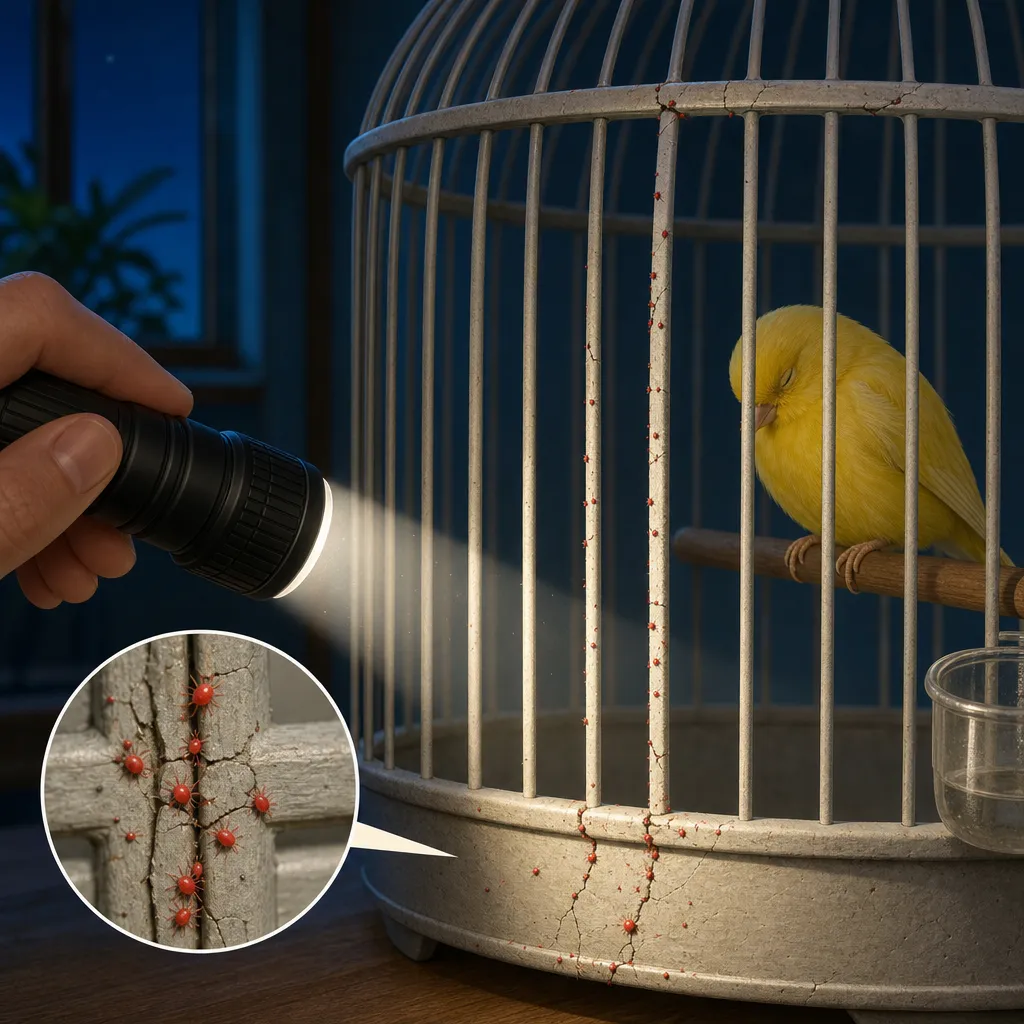
This is the most feared aviary parasite. Dermanyssus gallinae is a blood-feeding (haematophagous) mite: by day it hides in cage cracks, perch joints and under the litter; by night it comes out to bite sleeping birds. It turns from greyish-white to bright red after a blood meal.
2.1 How to recognize it
- Canaries restless at night, scratching and shifting on the perches.
- Anaemia: pale legs, beak and mucous membranes; birds exhausted in the morning.
- Moving red or black dots in cracks, corners and under perches.
- Chicks dying in the nest despite attentive parents.
2.2 The white-cloth test (night inspection)
The most reliable test is done in the dark, when the mites are active:
- Wait until deep night (at least 1-2 hours after lights out).
- Light the cage with a torch and wipe a white cloth or tissue through the cracks, under the perches and along the tray edges.
- Check the cloth: if moving red/brown dots appear and leave blood smears when crushed, that's confirmation.
- Repeat on several cages: red mite spreads quickly between neighbouring birds.
Tip: place a strip of corrugated cardboard or double-sided tape near the perches. By morning the mites will have taken shelter there: it's an excellent "monitoring trap" to track the infestation.
3. Scaly Leg (Cnemidocoptes)
Scaly leg is caused by the Cnemidocoptes mite (often C. pilae or C. mutans), microscopic and different from red mite: it does not suck blood but burrows tunnels in the horny layer of the legs, toes and, in advanced cases, the area around the beak. It develops slowly but is disfiguring if neglected.
- Symptoms: whitish, spongy, thickened crusts ("chalky look") on legs and toes; itching and flaking.
- Advanced cases: marked thickening, deformed toes, lameness, loss of scales and irregular nails.
- Spread: slow, by direct contact or via shared perches and equipment; often affects weakened or older birds.
Scaly leg is less "explosive" than red mite but needs specific diagnosis and treatment: the crusts must be softened and the mite smothered/eliminated. See the Treatments section.
4. Feather and Tracheal Mites
4.1 Feather mites
Several species live on or inside the feathers, feeding on keratin and skin debris. They are less dangerous than blood feeders but ruin the plumage and add stress.
- Symptoms: broken, "chewed" or holed feathers; a dull coat; the canary over-preens or scratches constantly.
- Note: don't confuse feather mites with stress, moult or protein deficiency. For abnormal feather loss see the feather-loss guide.
4.2 Air-sac / tracheal mite (Sternostoma tracheacolum)
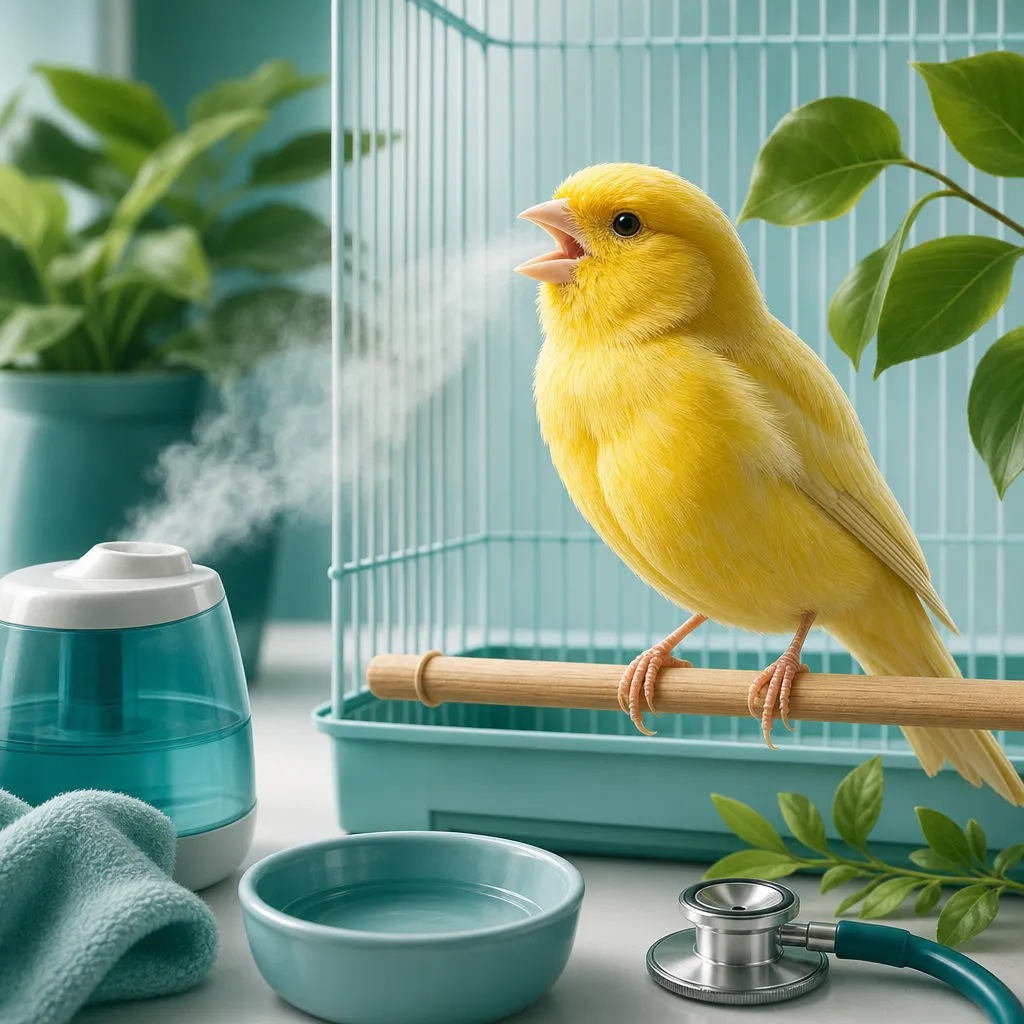
This is the most treacherous mite because it colonizes the respiratory tract (trachea, air sacs, lungs). Common in canaries and other finches, it can be lethal if untreated.
- Symptoms: wheezing or "clicking" breathing, sneezing, head shaking, tail bobbing, changed or lost song, open-beak breathing.
- Diagnosis: hard to see with the naked eye. In a quiet room, bring your ear close to the bird: a repeated respiratory click is a strong clue. Confirmation is veterinary (auscultation, tracheal transillumination or post-mortem exam).
- Treatment: almost always requires ivermectin under veterinary supervision; never improvise dosages.
Urgent: a canary wheezing and gasping with an open beak is a case for prompt veterinary care. The tracheal mite worsens quickly and must be told apart from mycoplasmosis and aspergillosis (see the diseases guide).
5. Symptoms and Diagnosis Compared
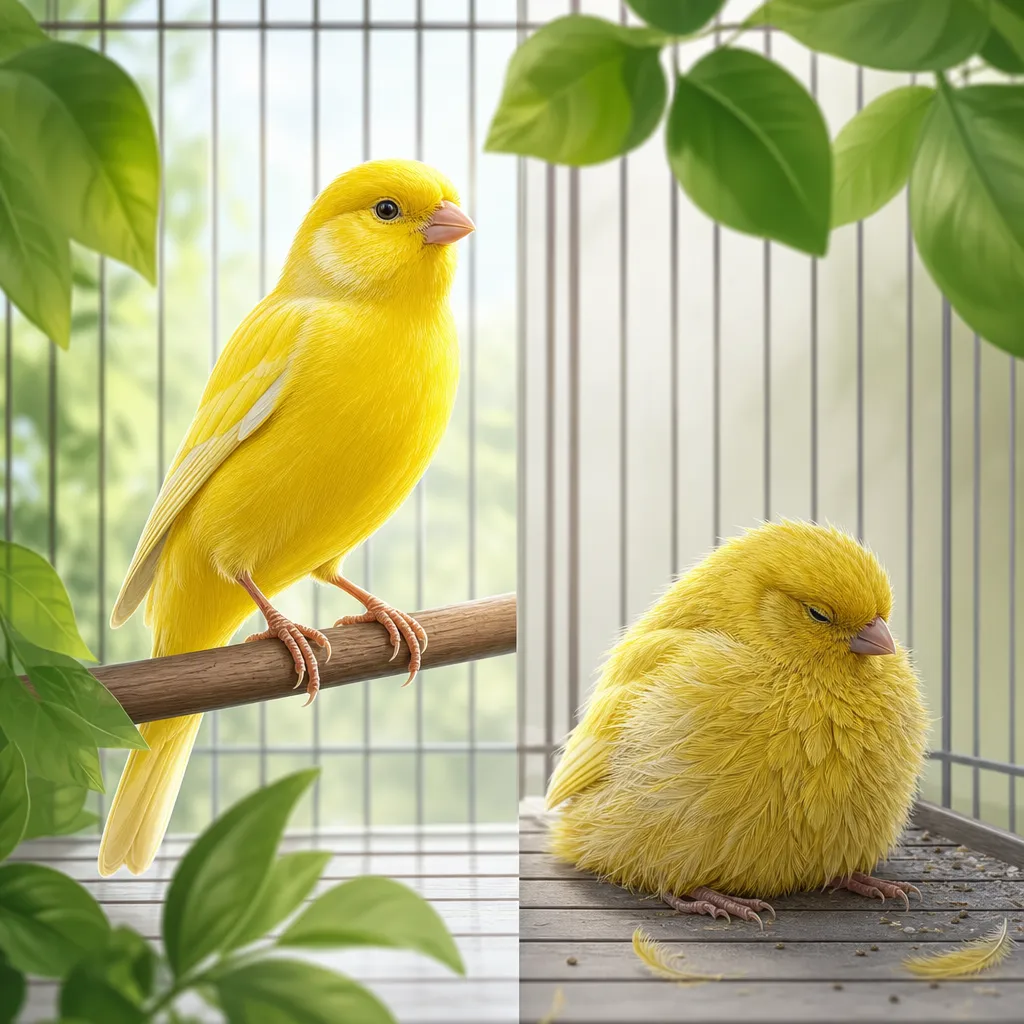
Each type of mite leaves a different "signature". This table helps focus your suspicion before diagnostic confirmation.
| Parasite | Where it acts | Key symptoms | How to diagnose | Severity |
|---|---|---|---|---|
| Red mite (Dermanyssus) | Environment/cage, bites at night | Night restlessness, anaemia, dead chicks | White cloth in the dark, monitoring traps | High |
| Scaly leg (Cnemidocoptes) | Skin of legs/toes/beak | Chalky crusts, thickening, deformity | Typical look, skin scraping by the vet | Medium |
| Feather mites | Feathers and skin | Broken feathers, itching, dull coat | Feather exam, magnifying glass | Low |
| Tracheal mite (Sternostoma) | Respiratory tract | Clicking breath, sneezing, lost song | Auscultation and veterinary diagnosis | High |
Many signs (ruffled plumage, apathy) are shared with other conditions: always cross-check your observation with the general diseases guide and the coccidiosis guide to rule out intestinal causes.
6. Treatments
⚠️ First of all: the products described here must be used with care. Ivermectin in particular has a narrow safety margin in small finches: a wrong dose can be toxic or lethal. Have your exotic vet specify the product, concentration and frequency. Never use dog, cat or cattle products "by eye".
6.1 Pyrethrum / pyrethrins (bird antiparasitics)
Sprays and powders based on natural pyrethrum or pyrethrins for birds are the first line against red mite and feather mites. They act on contact and have low toxicity when used as directed.
- Use only products made for birds and follow the manufacturer's instructions.
- Avoid spraying near the eyes, nostrils and beak; do not soak the bird.
- Repeat the treatment after a while (usually 7-10 days) to hit mites hatched after the first pass: eggs are not killed.
- Treat the environment and cage at the same time, not just the canary.
6.2 Ivermectin (only on veterinary advice)
Ivermectin is the main weapon against the tracheal mite and severe scaly-leg cases, because it works from the inside. That is exactly why it must be managed by the vet:
- The dose depends on body weight (a few grams in a canary): mistakes are easy and dangerous.
- It may be applied topically (one drop on the skin) or given per a veterinary protocol.
- Several spaced applications are needed to cover the parasite's cycle.
- Never combine it with other antiparasitics without the vet's approval.
6.3 Scaly leg
For scaly leg, besides ivermectin in serious cases, a "smothering" approach is used: paraffin oil or petroleum jelly spread over the leg crusts blocks the mites' breathing.
- Apply a thin film of oil/jelly to the legs every 2-3 days, gently.
- Do not force the crusts off: they soften and fall away on their own.
- Disinfect the perches, a frequent carrier of the mite.
| Target | Typical treatment | Important notes |
|---|---|---|
| Red mite | Pyrethrum spray/powder + environmental clean-up | Repeat after 7-10 days; treat the room |
| Scaly leg | Paraffin oil/petroleum jelly; systemic drugs only on veterinary prescription | Don't peel off crusts; disinfect perches |
| Feather mites | Pyrethrum spray for birds | Improve diet and hygiene for plumage recovery |
| Tracheal mite | Therapy only as prescribed by a vet | Urgent; tell apart from respiratory disease |
7. Environment and Cage Cleaning

Against red mite, environmental clean-up matters as much as treating the bird: most of the parasite lives hidden in the cage and the room, not on the bird.
- Empty and dismantle: remove birds, feeders, perches, nests and tray before you start.
- Boiling water and pressure: cracks are the favourite hideout. Very hot water or steam reaches where the spray cannot.
- White vinegar: for routine cleaning (water and vinegar) it is safe; avoid bleach, whose residues are toxic to birds' lungs.
- Replace the replaceable: cracked wooden perches and fibre nests are mite nests: better to renew them during an infestation.
- Treat the room: walls, shelves and cracks near the cages. Red mite walks at night from cage to cage.
- Dry thoroughly: moisture favours both mites and fungi (aspergillosis). Reassemble only on dry surfaces.
A cycle, not an event: mites have resistant eggs. Plan at least two or three cleaning + treatment cycles 7-10 days apart to break the breeding cycle.
8. Prevention Checklist
Prevention costs far less than a cure. Adopt these habits all year round, stepping them up during the breeding season.
- ☐ Quarantine of 15-20 days for every new bird, in a separate room
- ☐ Regular night inspection with the white cloth, especially in spring/summer
- ☐ Weekly deep clean of cages, perches and feeders
- ☐ Check the nests during breeding (red mite loves nestlings)
- ☐ Perches and nests replaced when cracked or worn
- ☐ Monitoring traps (cardboard/tape) to track mite presence
- ☐ Equipment not shared between cages without disinfection
- ☐ Room dry and well ventilated, away from wild birds
- ☐ Birds in good immune condition: proper diet and inbreeding under control
A genetically sound aviary copes better with parasites: keep an eye on the pedigree and the inbreeding coefficient so you don't weaken your birds' immune systems.
9. When to Call the Vet
Some situations should not be handled alone. Contact an exotic vet if you notice:
- Wheezing, clicking or open-beak gasping → suspected tracheal mite or respiratory disease: urgent.
- Marked anaemia (very pale legs/beak) and birds exhausted in the morning.
- Chicks dying in the nest despite good parents.
- Advanced scaly leg with deformed toes or lameness.
- An infestation that returns after two or three cycles of treatment and clean-up.
- Before using ivermectin or any drug with an uncertain dose.
Remember: the canary hides symptoms until the situation is serious. When in doubt, act early and have a professional confirm the diagnosis instead of giving drugs at random.
Try GenHub free tools
Simulate genetic pairings and calculate inbreeding, then sign up to unlock the full breeding software.
Also read: Diseases Guide · Coccidiosis · Feather Loss
Sources and further reading
General references on bird health and welfare:
Content drafted with AI support and human editorial review.