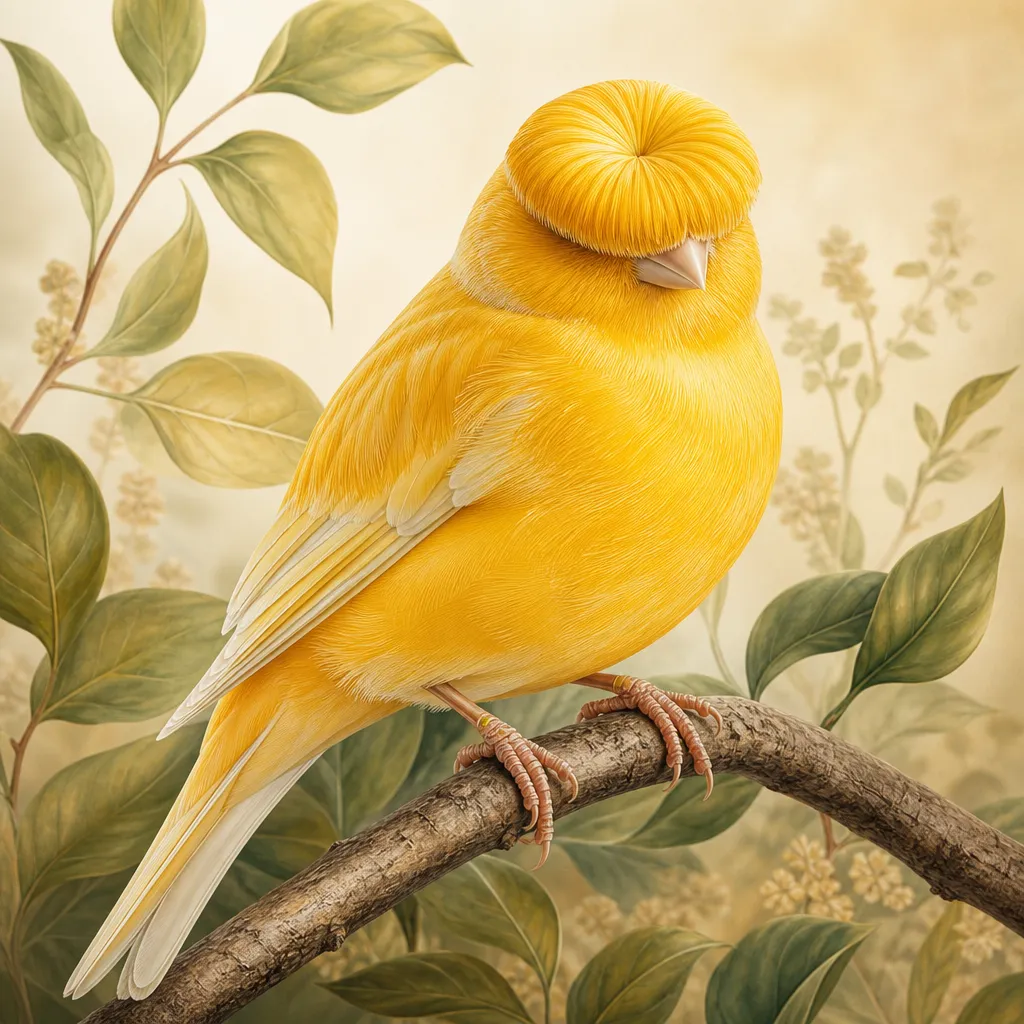
The Fiorino is an Italian frilled canary developed in the 20th century from crosses of frilled birds with crested type breeds. It is valued for orderly curly plumage ("frills") and, in some birds, a head crest. This guide covers the standard, places the breed among frilled types, and offers practical breeding notes.
In this guide:
1. Origins and standard del Fiorino
The Fiorino originated in Italy as a small frilled type often with a crested head. It is a type breed (shape and plumage), not a colour breed: judging focuses on structure and frill quality, not colour. In short the standard asks for:
Size and structure
- Small, compact size
- Compact body, lively carriage
- Abundant but orderly plumage
- Crest present in some birds
The three frill areas
- Giabò: breast frill
- Flanks: feathers rising symmetrically
- Mantle: back/shoulder frill
- Symmetry and regularity are decisive
The Fiorino's value is balance: clear but harmonious frills, without excess that spoils a clean outline.
2. The frilled breed family
Frilled canaries are type birds with curly plumage in defined areas (breast, flanks, back). Within the group, breeds differ in size, frill style and posture. The Fiorino is among the smallest and most compact; others emphasise size and plumage opulence. For the full category overview see the canary breeds guide.
3. Fiorino, Padovano and Parisian Frill compared
Broadly, three often-mentioned frilled breeds differ as follows:
| Breed | Size | Distinctive traits |
|---|---|---|
| Fiorino | Small | Compact Italian frill, often crested; balance and symmetry |
| Padovano (Arricciato Padovano) | Large | Large Italian frill, often crested, abundant plumage |
| Parisian Frill (Arricciato di Parigi) | Large | The most imposing and "baroque"; extensive opulent frills, plain head |
In practice the Fiorino is the smaller, more compact "frill + crest" idea, while Padovano and Parisian Frill play on size and plumage richness. Official classifications and standard details can vary by federation — always check your association's current score sheets.
4. Breeding notes
- Frill quality and symmetry: the most judged trait. Select breeders with clean, regular, mirror-image frills; discard birds with messy or asymmetric feathers.
- Crest, when present: crested lines need the same caution as other crest canaries — never pair two crested birds, because a double dose of the crest factor is typically lethal (see the Gloster guide for genetics detail).
- Husbandry: abundant plumage needs clean, dry housing; keep nests and perches clean so frills stay tidy.
- Condition: balanced feeding and careful moult management keep show plumage (see feeding and diseases).
5. Genetics and GenHub tools
Frill expression depends on many factors and breeder selection. Among simulable traits, the GenHub genetic predictor models canary genetics including the crest locus ("Gloster Ciuffo", alleles Cr/cr), also useful for crested frill lines. Use it to plan pairings alongside the genetics guide.
Try GenHub free tools
Simulate genetic pairings and calculate inbreeding, then sign up to unlock the full breeding software.
6. Fiorino checklist
- ☐ I understand where Fiorino sits among frilled breeds
- ☐ I select for frill symmetry and regularity
- ☐ On crested lines I never pair crest × crest
- ☐ I keep hygiene and plumage (clean nest/perches)
- ☐ I planned pairs with the GenHub predictor
Also read: Canary breeds · Gloster · Genetica · Pairing · Feeding · Genetic predictor
Questions about breeding and planning? Contact us.
Content drafted with AI support and human editorial review.