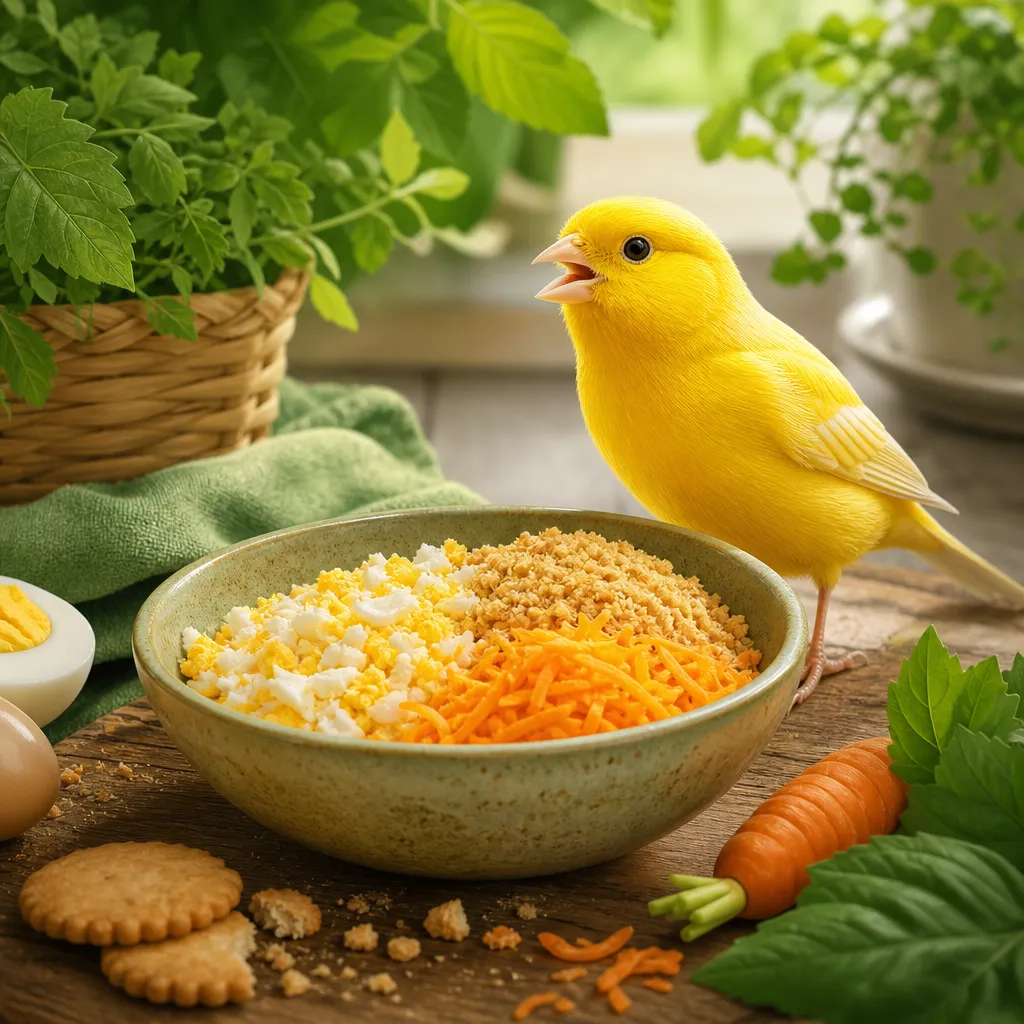
Soft food (pastoncino / egg food) is the moist feed that supports canaries in breeding, moult and weaning. It does not replace seed: it complements it with protein, moisture and micronutrients. In this guide you will find the basics, seasonal recipes, hygiene rules and links to the chick calendar and the feeding guide.
In this guide:
1. What soft food is and when to offer it
Soft food (egg food / rearing paste) is a moist mix based on flours, egg, vegetables or commercial products. It is especially useful when parents must feed chicks and when birds need more protein (breeding and moult).
Breeding
From 2–3 weeks before pairing until weaning: fresh 2–3 times a day.
Moult
Light protein and vitamin support; avoid excess fat.
Rest
Reduce frequency and amount; keep seed and greens as the base (see feeding guide).
2. Basic ingredients
You can use quality commercial soft food or prepare it at home. In both cases the rule is: fresh, clean, accepted by the parents.
- Dry base: powdered soft food / crumbled biscuit / flours for seed-eating birds.
- Protein: hard-boiled egg (yolk and/or white), sometimes a little low-fat yoghurt.
- Moist vegetables: grated carrot, apple, cooled cooked broccoli, chicory (small amounts).
- Useful extras: sprouts (well dried), a pinch of vitamin-mineral supplement in critical phases.
- Always available: cuttlebone, grit (if used in your method), clean water.
Caution: do not improvise with toxic ingredients (avocado, chocolate, salt, onion, garlic). For the safe/toxic list see the feeding guide.
3. Recipes and amounts by season
Amounts depend on the number of pairs and chicks. Better prepare little and refresh often than leave sour soft food in the cage.
| Stage | Frequency | Practical tip |
|---|---|---|
| Pre-breeding | 1×/day | Small amount to train them; increase protein gradually |
| Incubation | 1–2×/day | Keep the habit without overloading the hen |
| Chicks 0–15 days | 2–3×/day | Fresh soft food, creamy but not liquid; remove leftovers |
| Weaning | 2×/day | Move to a more granular texture; also offer soft seed |
| Moult | 3–5×/week | Moderate support + greens; avoid continuous excess |
| Rest | 0–2×/week | Priority to seed and plant variety |
“Breeding” sample recipe (for 2–4 pairs)
- 2–3 tablespoons of quality dry soft food.
- ½–1 finely chopped hard-boiled egg (or yolk if birds prefer it).
- 1 tablespoon grated carrot (dry).
- A little liquid (water or unsalted vegetable broth) to a crumbly-moist consistency.
- Mix and serve immediately; remove after 2–4 hours (sooner if hot).
Every aviary has its preferences: watch what parents actually feed and do not change the formula every day mid-clutch. For eggs and incubation: egg guide.
4. Soft food and chick weaning
In the first days chicks depend on parental feeding. Around 15–25 days they start pecking alone: keep soft food available and gradually reduce dependence on the parents.
- Offer soft food in a low, stable dish.
- Move from creamy to drier/granular texture.
- Typical separation around 30–35 days (assess vigour).
- Note the dates: the chick calculator helps.
For the full breeding context: pairing.
5. Storage and hygiene
Do
- Prepare amounts to be eaten within a few hours
- Wash dishes every day
- Store the dry base in a cool, dry place
- Freeze hard-boiled egg portions only if you manage thawing well
Avoid
- Leaving sour or fermented soft food in the cage
- Reusing leftovers from the day before
- Dishes soiled with droppings
- Mixes that are too liquid (fouling and bacteria risk)
Diarrhoea and enteritis often start from food hygiene: if you suspect disease, see the disease guide.
6. Common mistakes
- Too much, too late: soft food only “when there are chicks” without training the parents.
- Constant recipe changes: parents may refuse and chicks stay hungry.
- Poor hygiene: the most banal (and dangerous) cause of digestive problems.
- Only soft food, no variety: seed and greens remain essential.
- Ignoring genetics and vigour: weak chicks feed less well; plan pairs with the genetic predictor.
7. Chick calendar and planning
Soft food works best when you know which stage the chicks are in. Use GenHub tools to sync weaning, births and pairings.
Try GenHub free tools
Simulate genetic pairings and calculate inbreeding, then sign up to unlock the full breeding software.
8. Daily soft food checklist
- ☐ Prepare fresh, a few grams more than needed
- ☐ Serve in a clean dish, away from dirty perches
- ☐ Remove leftovers within a few hours
- ☐ Watch whether parents actually feed
- ☐ Adapt texture to chick age
- ☐ Note hatch and weaning dates on the chick calculator
Also read: Diet by phase · Feeding · Moult · Eggs · Pairing · Genetics · Diseases · Breeds · Chicks · Genetic
Questions about breeding nutrition? Contact us.
Content created with AI support and human editorial review.